|
|
|

|
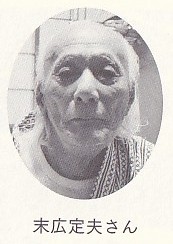
Tadao Suehiro
|
|
|
Substitute Weapon: Volunteered and Gave Up Dream of Flying in Wide Open Sky
(Daitai heiki: Ōzora tobu yume akiramete shigan)
Researched and written by Shūji Fukano and Fusako Kadota
Pages 279-281 of Tokkō kono chi yori: Kagoshima shutsugeki no kiroku
(Special attacks from this land: Record of Kagoshima sorties)
Minaminippon Shinbunsha, 2016
"We are going to crash into an enemy ship with this?" At the end of January
1945 at the Navy's Kawatana Torpedo Boat Training Base at Ōmura Bay in
Nagasaki Prefecture, Petty Officer 2nd Class Tadao Suehiro (88 years old,
resident of Futsuhara, Ariake-chō, Shibushi City) gasped involuntarily when
he saw before his eyes for the first time the special (suicide) attack weapon
that he would be given instead of an aircraft.
It was a small shin'yō special attack boat. It had a 250-kg
bomb loaded in the bow section just like an aircraft bomb, but the boat frame
was made of plywood, and it was noteworthy that the power came from a poorly
built standard truck engine that had been diverted from regular production.
Suehiro attended West Shibushi Youth School, and he volunteered in October
1943 for the Yokaren (Navy Preparatory Flight Training Program) 5th Toku Otsu
Class. He entered at Mie Naval Air Group. West Shibushi Youth School had the
only glider training facility out of all youth schools in the country. It was
located at Oshikiri Coast of Shibushi Bay. Suehiro also trained there and
nurtured his yearning to fly in the wide open sky.
Suehiro explains that at Yokaren glider training "I was a star among my
fellow students since I had a lot of flight experience. Naturally, I thought
that I would be able to fly in a frontline aircraft."
However, even after the Yokaren program ended, flight training with Type
93 Intermediate Trainers could not be started. I transferred from Mie to Kōyasan
Detachment in Wakayama
Prefecture. On December 13, 1944, the Toku Otsu 5th and 6th Classes were called
together, "Double time to line up in the auditorium."
The commanding officer made the following preliminary remark, "The training
environment for aircraft volunteers has become extremely difficult." He
continued, "We are recruiting non-aircraft Special Attack Corps members. I hope that
once again you will have the backbone to adapt to the severe war situation."
Suehiro was requested to submit his preference on paper by writing a double circle if
he "earnestly desired" to be a non-aircraft Special Attack Corps member, a circle
if he would "volunteer if it was required," and an X if he "desired an aircraft
until the end."
"I wanted to fly an airplane, but when it was said that we should adapt to
the war situation, it was natural that I would write a double circle," says
Suehiro. He never would have thought that the substitute weapon was made of
plywood.
Since the Pacific War turned into an aerial conflict at its core, the Navy
strengthened its recruiting of Yokaren trainees as the major force of aircraft
crewmembers. As a result, the total number of new Yokaren Kō, Otsu, and Toku
Otsu trainees in 1944 reached 117,000. This was more than ten times the total of
11,000 Yokaren trainees recruited before the war's start.
However, in March 1945, the Navy had just 1,600 trainer aircraft. Along with
a fuel shortage brought about by a standstill in raw material shipments,
trainees could not be given sufficient training time, and there was a collapse
in plans to train aircraft crewmen.
Nevertheless, no materials from that time remain to offer a glimpse into the reasons why the
military went ahead with large-scale recruitment.
Be that as it may, Yokaren trainees in those days were courageous. Suehiro
finishes by saying, "There was no choice but to perform our duties with the weapon
that we were given. We were diligent in training with only that thought."
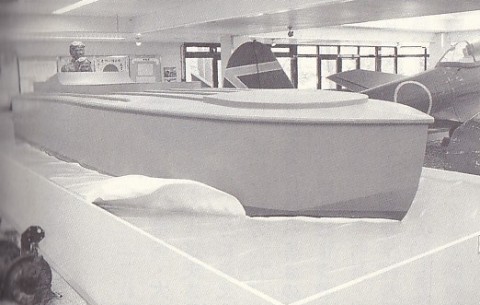
Full-scale model of Model 5 shin'yō boat
that Sadao Suehiro would man
(provided by Chiran Peace Museum for Kamikaze Pilots)
Translated by Bill Gordon
June 2026
HOME >
Stories > Substitute Weapon: Volunteered and Gave Up
Dream of Flying in Wide Open Sky
|
|
