|
|
|

|
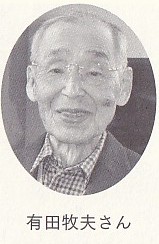
Makio Arita
|
|
|
Frequent Accidents: Simple Construction With Serious Flaws (Jiko tahatsu:
Kan'i kōzō, ōki na kekkan ni)
Researched and written by Shūji Fukano and Fusako Kadota
Pages 282-284 of Tokkō kono chi yori: Kagoshima shutsugeki no kiroku
(Special attacks from this land: Record of Kagoshima sorties)
Minaminippon Shinbunsha, 2016
At the end of January 1945, Navy Petty Officer 2nd Class Tadao Suehiro (88
years old, resident of Shibushi City, Ariake-chō, Futsuhara) went to Kawatana Torpedo Boat School in Nagasaki in order to become a crew member of a
small shin'yō special (suicide) attack boat. He spent about two
months in proficiency training such as attacks at Sasebo Harbor on Japanese
ships selected as targets. On March 24, he was assigned to the 124th Shin'yō
Squadron (Arita Unit).
However, the deployment location had not yet been decided. Makio Arita (92
years old, Takasaki City, Gunma Prefecture), who was the unit commander,
explained, "It was planned that we would advance to Okinawa or Ishigakijima, but
the Battle of Okinawa began at the end of March, so it was difficult to do
this." Arita as First Lieutenant commanded over 200 men, which included an
infrastructure unit that maintained base facilities.
In the first part of May 1945, the deployment location for the Arita Unit was
decided to be at Kataura in Kasasa Town (now part of Minamisatsuma City). The
Arita Unit came under the 5th Special Attack Corps 32nd Totsugeki Unit. When signs of defeat in the Battle of Okinawa became clear, the Navy predicted that
the American military's next invasion would be at southern Kyūshū. The shin'yō
section of the 32nd Totsugeki Unit, which was responsible for defense of the
Kagoshima Prefecture mainland, increased its originally planned two squadrons to
13 squadrons, and it was decided to have 500 boats posted primarily to the
southern part of Satsuma Peninsula. The Arita Unit was one of these, and "it
had the role of attacking the American fleet if they came to Fukiage Beach,"
Arita says.
On June 3, the 25 Model 5 shin'yō boats of the Arita Unit headed
toward Kataura from Sasebo Harbor by navigating under their own power. They
proceeded south at night from island to island since the plywood boats would not
have a chance if attacked by enemy fighters during the day. They were not able
to move when there were rough seas, and it took more than ten days to get to
Kataura.
Arita explains, "Group operations were difficult when there were surging
waves since the boats were small. When the boats were engulfed by waves, there
were engine troubles. I think that attack success was dependent on the weather."
In the end, the 13 squadrons in the 32nd Totsugeki Unit did not make any
sorties. However, on August 19, four days after the end of the war, tragedy
struck when eight squadron members died as a result of an accidental explosion
that occurred while working to disconnect fuses for shin'yō
explosives. For Arita, it is "a matter of great regret that even now after 70
years cannot be forgotten."
Accidental explosions of shin'yō boats also happened in the
Philippines and in Kōchi Prefecture, and the lives of many squadron members were
lost. It was the harmful result of forcibly cramming a large amount of
explosives, an engine, and fuel into a simple boat frame of about five meters in
length.
In comparison to an aircraft, a shin'yō boat was expected to be used
as a "decisive battle weapon" that could be produced in large volumes for a
short period by simplifying its construction. However, this simplification in
construction resulted in major flaws.
Masahiro Inada (71 years old, Seika Town, Kyōto Prefecture), who has
researched the Kyūshū shin'yō squadrons for many years, says, "I feel
that utilization of shin'yō boats by letting each location be
responsible for setting up its own base was not a clear-cut battle strategy. On the
other hand, the American military had experience with shin'yō boat attacks
in the Philippines and at Okinawa and had suitably refined countermeasures
such as floating logs and rope around its ships. It the shin'yō
squadrons had made sorties, it is
expected that they would have met with tragic results."
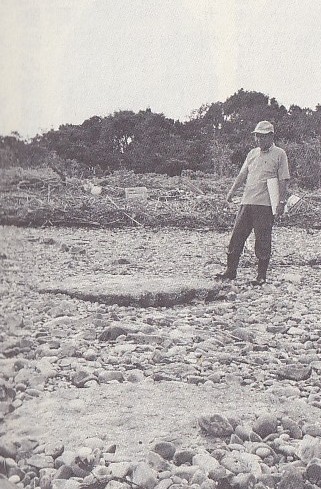
Remains of Kataura Base where 124th Shin'yō
Squadron was stationed. A very small part remains of a
concrete slope used to launch shin'yō boats to sea.
(September 2015, Minamisatsuma City, Kasasa Town, Kataura)
Translated by Bill Gordon
May 2026
Related Web Page
HOME >
Stories > Frequent Accidents: Simple Construction
With Serious Flaws
|
|
