|
|
|

|
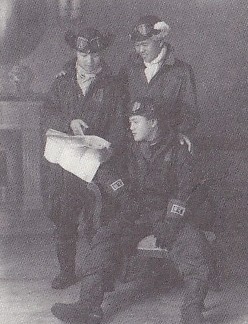
Portrait of Kotohira Suishin Squadron members taken by
Sukejirō Mawatari
|
|
|
Cherished Yosegaki from Kotohira Suishin Squadron Members (Kotohira
Suishin taiin no yosegaki hokan)
Researched and written by Shūji Fukano and Fusako Kadota
Pages 198-200 of Tokkō kono chi yori: Kagoshima shutsugeki no kiroku
(Special attacks from this land: Record of Kagoshima sorties)
Minaminippon Shinbunsha, 2016
At Mawatari Photo Studio, which opened business in the Taishō Era (1912-1926)
at Minato 2-chōme in Ibusuki City, there remains a yosegaki, which is
a writing paper, card, or flag with messages written by various persons. This
was written for Sukejirō Mawatari (deceased), the original owner of this photo
studio, by teenagers who were Kamikaze Special Attack Corps Kotohira Suishin
Squadron members who came to have their photos taken as mementos to send to
their families prior to their sorties toward Okinawa from Ibusuki Naval Air
Base.
The Kotohira Suishin Squadron was formed at Takuma Air Base in Kagawa
Prefecture. The first battle when seaplanes participated in special (suicide) attacks was
during the 4th Kikusui Operation of the Okinawa air special attack operations
(April 22-29, 1945). In those days these seaplanes took off from Ibusuki Base.
"Most residents of Ibusuki City did not know about this," says Shigetaka
Mawatari (89 years old), who is the son of Sukejirō and who helped him in
photo shoots
"When one looks at the writing on the yosegaki, it is soon clear that
these men were Special Attack Corps members. Therefore, during the war my father
did not even show it to his family."
The Kotohira Suishin Squadron used both three-man Type 0 Reconnaissance
Seaplanes and three-man Type 94 Reconnaissance Seaplanes as special (suicide)
attack aircraft. According to battle reports and other information from Takuma
Naval Air Group, 34 men in the Kotohira Suishin Squadron died when 15 planes did
not return as part of three sorties on April 29, May 4, and May 28. Among the
seven men who wrote on the yosegaki, there were two who died in battle.
On May 4, one American destroyer was sunk when the Kotohira Suishin Squadron
and the 1st Sakigake Squadron, which was formed from the Kitaura Naval Air Group, made
sorties. As retaliation on May 5, Ibusuki Base was attacked for the first time in an
aerial bombardment by B-29 bombers and suffered devastating damage.
Shigetaka, a student at Ibusuki Junior High School under the prewar
educational system, was determined to join the Yokaren (Naval Preparatory Flight
Training Program), and some of his classmates died in special attacks. In 1971,
when memorial services started at the former site of Ibusuki Base, he had
friendly interactions with former Special Attack Corps members.
He says, "They told me about how an old Type 94 Reconnaissance biplane had a
500-kg bomb attached, which made it very difficult for it to take off from the
sea due to the weight. When I heard their stories, I understood well the
recklessness of seaplane special attacks."
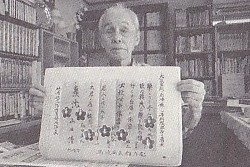
Shigetaka Mawatari with yosegaki from
Special Attack Corps members
(Minato 2 chōme, Ibusuki City)
Nearly all of these former Corps members have passed away due to
old age. Sukejirō says, "To the best of my poor ability, while alive I want to continue to
speak out about the tragic special attack operations carried out
from this base."
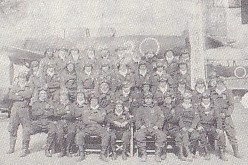
Kotohira Suishin Squadron, which
made seaplane special attacks
three times from Ibusuki
Photos provided by Shigetaka Mawatari
Translated by Bill Gordon
August 2026
Related Web Pages
HOME >
Stories > Cherished Yosegaki from Kotohira
Suishin Squadron Members
|
|
